Liza Talusan: Running Saved My Life
I started running so that I could increase my chances of survival. I am a second generation Filipina American, the youngest of three daughters and the big sis to two brothers. The role of family is central in Filipino culture, and, in 2006, when my oldest sister, Mary, was diagnosed with breast cancer, the course of my family’s life was forever changed. Because Mary was young (barely in her mid-30s), the doctors recommended she undergo genetic testing for cancer markers. She did, and her results were positive for the BRCA gene - the genetic mutation that exponentially increases the chances of developing breast and ovarian cancers by 80% and 60%, respectively. Her positive test results spurred other members of my family to get tested, and, maybe with no surprise, my other sister, Grace, and I also tested positive. One of the main courses of action for treatment was to pre-emptively have a mastectomy (removal of breasts) and oophorectomy (removal of ovaries).
Initially, I was reluctant to take the drastic step of surgery. I was a mom to three kids under the age of six, and I already felt like I was barely keeping my head above water. I was already on a regular schedule (every 6 weeks) of surveillance with mammograms and ultrasounds, and the fear of getting an official diagnosis was a lot to carry emotionally. Eventually, I decided the surgery to reduce my risk of cancer was the best solution.
New Year Resolutions
My first round of surgeries, a bilateral mastectomy, was scheduled to be in November of 2010. I knew that in order to give myself a fighting chance during recovery, I had to get as healthy as possible going into the operation. Logically, I thought, “what better way to do that than to run a marathon?!”
Had I even run a half marathon before? No. Was I even any good at the sports I had played in my youth? Also…no. But I wanted to do something to reclaim my body and get my body into peak condition before, essentially, choosing to cut it open. While a marathon was (and still is) a bucket list item, I decided that with my schedule of medical surveillance, working full time, and taking care of my family, it was more reasonable (and somewhat more feasible) to train for two half marathons (half + half = whole, right?).
I knew I did not want to do this alone. Over the next several months, I volun-told my friends to join me on this training journey. They all committed to showing up for me, and it made a world of difference. There were many, many days I did not want to workout or run at all, and the thing that always ended up bringing me to my feet was knowing there were friends on the other side (literally) who were waiting for me.
During that eleven-month journey towards my mastectomy, I started an online blog, “Marathon B4 Mastectomy,” and through that, I connected with many other women who were either also preparing to undergo surgery themselves or who were supporting loved ones who were pre-op. The “Mb4M” Team grew to reach families across the country, and it made me realize how, at the time, there was such little community, support, and resources for women dealing with breast cancer and specifically, with the BRCA gene. In fact, public opinion in 2010 criticized women for undergoing the pre-emptive surgeries, calling it a “mutilation of our bodies.”
Though I was running in community with friends, I also had trouble finding other Asian American women who were going through these types of health challenges, and that added to my existing feelings of isolation. Thankfully, I heard about two organizations, Asian Women for Health and Facing Our Risk, where I was able to receive information and help that was geared specifically to me, a Woman of Color, in my breast cancer-fighting journey.
Race Day
On June 13, 2010, I settled into my hotel room in Worcester, Massachusetts, the night before my first half marathon. My husband had graciously offered to tend to and keep our kids at home, so that I could get a good night’s rest peacefully on my own. To calm my pre-race nerves, I opened my computer to see a message from one of my Mb4M teammates, Emily, who had run her first half marathon as a part of pre-op prep, earlier that morning. Her words brought me to tears:
Thank you for helping me see myself through different eyes – as a competent, strong, kick-ass mama. Thank you for giving me the courage to try, and the self-worth to do this for myself. Thank you for showing me the world through new eyes…for helping me look at my children in a new light, and for wanting to be the best for them that I can. Thank you for connecting me to something so much bigger than myself; although I ran alone, I never *felt* alone. I know you’ve said that everyone has done so much for you on this journey… But Liza… What you’ve given me has been tremendous. I will be forever grateful.
I was stunned and incredibly moved to see my own journey bear such an impact, since I ordinarily felt as if I was the grateful recipient of the motivation from others. Emily’s voice made me realize how important it was to see one’s own journey reflected in the world and that representation mattered, because we all mutually benefit. Life is too hard to try to navigate alone!
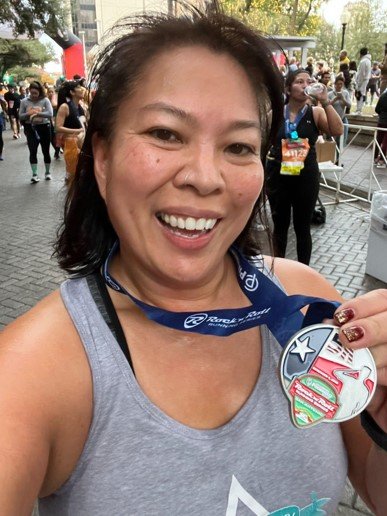
On June 14, 2010, I completed my first half marathon before my mastectomy, and later, on October 11, 2010, I completed my second half marathon, just before my surgery the following month.
Present Day
What have I learned about my body these past sixteen years since my mastectomy? I know that I am strong. I know that I am capable. I know that I am worth the attention I pay to my body. In the sixteen years following my first round of pre-emptive surgeries, I have run countless more half marathons and races, including multi-stage runs across the French, Swiss, and Italian Alps, and I am currently working towards earning my second degree in my black belt in mixed martial arts! That first running journey in 2010 allowed me to invest in my health. Yes, post-op recovery was painful and long, but the muscles – physical and emotional – I had developed pre-op literally helped me get out of bed each day.
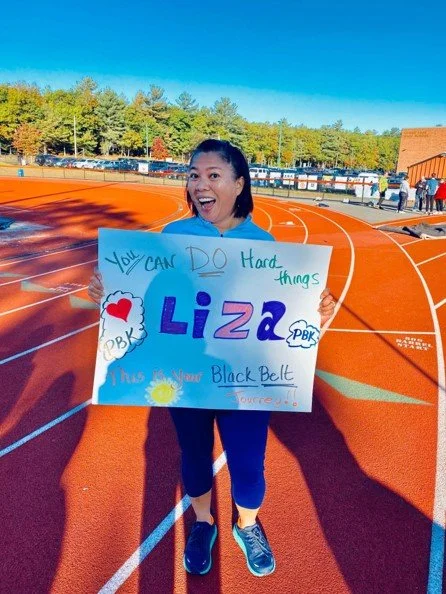
Today, running is how I honor my body – the parts I have lost as well as the parts I still have. Running is how I honor those who have experienced loss due to cancer and who have also survived.
For me, running is about community: encouraging others, supporting people in their goals, and celebrating their accomplishments! The beautiful thing about running is that when we show up for a run, we are not just benefiting ourselves; we are impacting others. When I run, I am not only running for my own gain; I run for my children, my family, my friends, and all those after me who are also navigating challenging health issues and trying to find their way home in their bodies. In the words of Des Linden, “keep showing up,” with whatever parts we have, with whatever amount of energy exists, because each day of life we get is an opportunity to be grateful. #diversewerun
Find Dr. Liza Talusan on Instagram at @ltalusan or listen to her podcast, “Lessons From the Messy Middle.” Liza is the author of the book, The Identity Conscious Educator, and, while she is not writing books and teaching in the classroom, she is leading organizations and corporations in making anti-bias structural changes, running across the Swiss Alps, and enjoying cotton candy with her family.tja
This story is a part of a feature series in collaboration with writer and activist Carolyn Su, who is the co-host of the Making Strides Podcast and creator of the story-telling platform, Diverse We Run. Together, the 26.2 Foundation and Diverse We Run seek to spotlight the running journeys of BIPOC athletes, in order to bring awareness and understanding of the experiences unique to the BIPOC community so that we might create a more equitable and accessible future for the sport.